
The principles behind the work
Forensic examinations rest on a small set of principles. They are guides to reasoning, not laws of nature, and each has limits.
| Principle | Idea | Limit to remember |
|---|---|---|
| Law of exchange (Locard) | Contact can transfer material between people, objects and places | Transfer may not happen, and traces can be lost or missed |
| Principle of individuality | No two objects are exactly alike in every detail | Being different doesn't mean we can always measure the difference reliably |
| Law of comparison | Only like can be compared with like: questioned samples against known samples of the same kind | You need good reference samples |
| Principle of linkage | Evidence can connect scene, victim and suspect (the "crime scene triangle") | A link supports contact, not guilt |
| Law of probability | Findings are weighed using chance and statistics | The numbers depend on good population data |
| Law of progressive change | Everything changes with time: stains dry, DNA degrades, scenes alter | Evidence must be collected and preserved quickly |
| Law of analysis | Testing goes from simple to complex, and non-destructive before destructive | Samples can be used up, so plan the order |
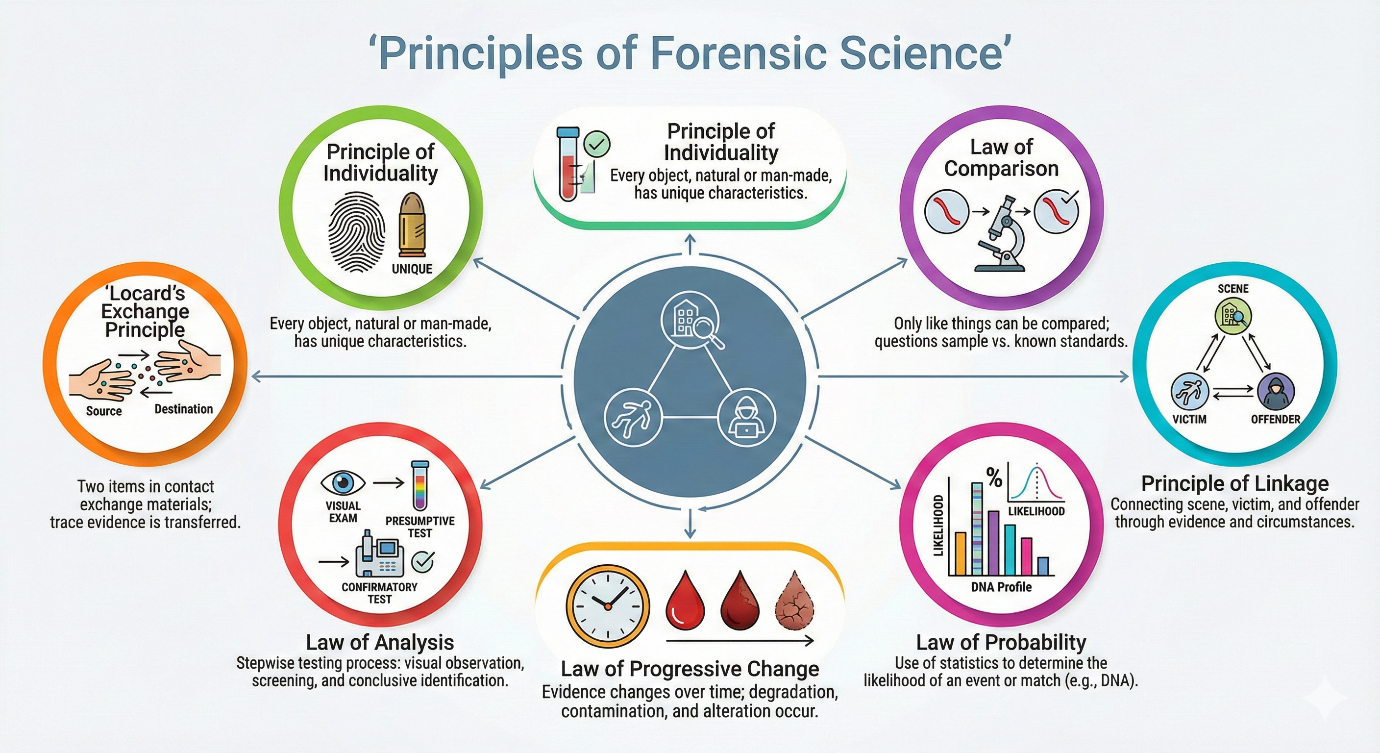
Locard's exchange principle is about contact, but the question a court often cares about is activity: how did the material get there? The diagram below shows why those are different questions.
Interactive diagram
Which question is the evidence answering?
The same bloodstain can be asked about at different levels. Each level up needs more information, and a finding at one level does not answer the level above. Select a level.
“Whose blood is this stain?”
The two sides might say
The bloodstain came from Person A, or from someone else.
To address it you need
Also: tests showing the body fluid really is blood, and that the DNA came from it.
A scientist can evaluate the findings at this level, if the information is available.
The same trace can be asked about at different levels
The expert's role and the law in India
A forensic expert examines the scene, analyses evidence in the laboratory, interprets the results without bias, and explains them in court. In India, new criminal laws replaced the old codes in July 2024:
| New law (2023) | Replaced | Relevance |
|---|---|---|
| Bharatiya Nyaya Sanhita (BNS) | Indian Penal Code, 1860 | Defines offences |
| Bharatiya Nagarik Suraksha Sanhita (BNSS) | Code of Criminal Procedure, 1973 | Investigation procedure; reports of government scientific experts (formerly CrPC Section 293) |
| Bharatiya Sakshya Adhiniyam (BSA) | Indian Evidence Act, 1872 | Opinions of experts (Section 39, formerly Section 45) |
Other laws often used: the Information Technology Act, 2000 (electronic evidence and cybercrime) and the Narcotic Drugs and Psychotropic Substances (NDPS) Act, 1985 (drug identification).
Ethics: what makes an expert trustworthy
- Integrity: never change, invent or hide results.
- Objectivity: the same standards whichever side asked for the work.
- Confidentiality: protect case information and the people involved.
- Competence: work only within your expertise and say so when a question is outside it.
- Fair testimony: report findings that weaken a case as clearly as findings that support it.
Pause and answer
- Which principle explains why a scene should be examined as soon as possible?
- Which 2023 law contains the provision on expert opinion?